Better At Research & The ARC Prize
December 23, 2025
Getting Better At Research
Last semester I sat a course on how to properly write a research paper. The course was extremely useful as I believe my academic writing has, in the past, been quite lacking (and I refuse to use LLMs to “fix” my papers). There were many, many insights I took from the course, but one of the best ones came towards the last few weeks: “You should keep a daily journal of your research project.”
The lecture covering the suggestion was way too late in the course to be useful for the course itself, but the concept hit me like a ton of bricks. I couldn’t believe that I hadn’t just figured out to do that myself. I use a modified version of the Zettelkasten technique whenever I read a book or research a topic for fun or profit (I use the Obsidian application if you’re curious). Making a daily journal of experiments in a methodical way would not only be useful for knowledge retention, using the backlinks feature would make putting a research paper together so much easier.
I hearkened back to 8th grade biology class, and I remember we had to use a notebook for every experiment we ran. I think this is because in industry, in a chemistry lab, those lab notebooks become legal documents. This seemed like a great idea to implement in AI labs - both for research purposes and, if there is ever an “AI governing body”, as legal proof.
I decided to try to use the chemistry version as a template to get started. Here is a basic example of what you’d find in a chemistry version of a lab notebook:
Personally, I prefer using physical notebooks for most of my real world thinking and note taking, but as I mentioned before, I transfer most of that information into my Obsidian “vault”. Here is the markdown template I use within Obsidian:
---
project: {{title}}
date: {{date}}
---

# {{title}} Experiment

## Purpose

> ==The purpose of the experiment==

## Materials

> ==The materials used. Services, machine configurations, libraries, etc==

## Procedures

1. ...
2. ...

## Data Tables

> ==Data to be used in the experiment==

| X     | Y                   |
|-------|:-------------------:|
|  1    |           1         |
|  2    |           3         |
|  3    |           7         |

## Results Tables and Graphs

| X     | Y                   |
|-------|:-------------------:|
|  1    |           1         |
|  2    |           3         |
|  3    |           7         |

## Analysis

- Observations
- Possible Errors
- Your Opinion

## Conclusion

- Interpret the results
- Tell what happened
I’ve been using this technique now on a few research projects I am playing with as possible thesis ideas, and it has been a game changer for me. I highly recommend implementing something like this if you don’t do it already.
ARC Prize
One of the projects I’ve been toying with is a new model to solve the ARC Prize. I am not under any delusion here. It is highly unlikely that the ideas I am trying will be the solution to the prize. However, the things I am trying, if they even kind of work, are crazy enough to make some interesting papers.
I am trying to tackle the smaller puzzles first. The 4x4 versions:
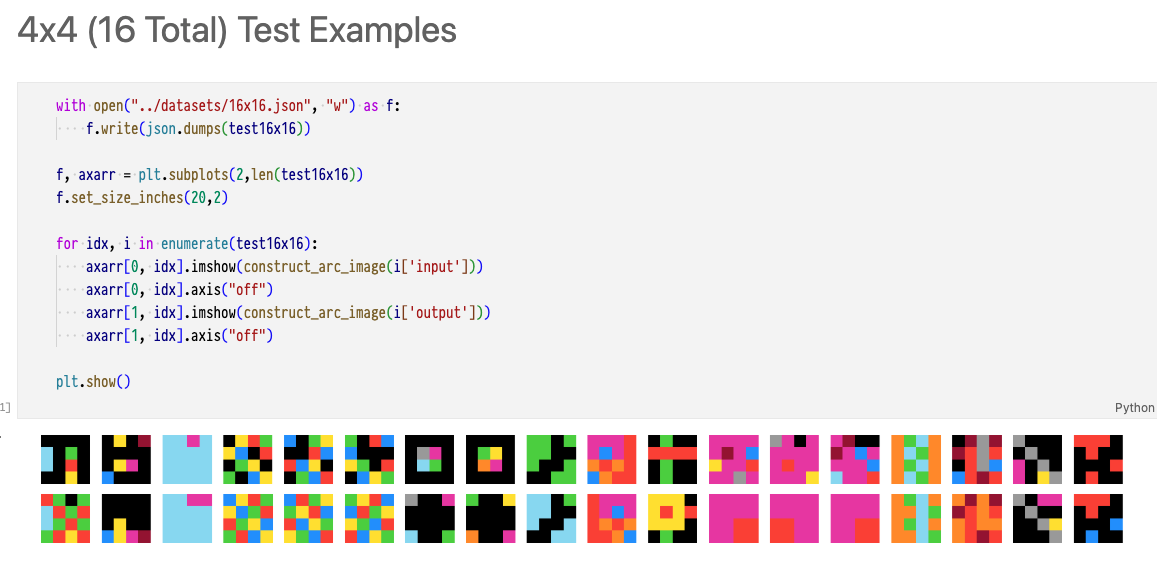
Now, I don’t really want to talk about what I am doing specifically because I don’t want someone smarter and better financed to “beat me to the punch” so to speak (Not that that is likely, but still). However, I has some fun and interesting results, and I wanted to show a few examples of the thing trying its best to solve one of the puzzles:
While it’s a bit like trying to run an ultramarathon without a support crew when you can barely run a 5k, I am learning a lot by even trying. If you’re even mildly into building AI/ML models I recommend you give the ARC Prize a go!